
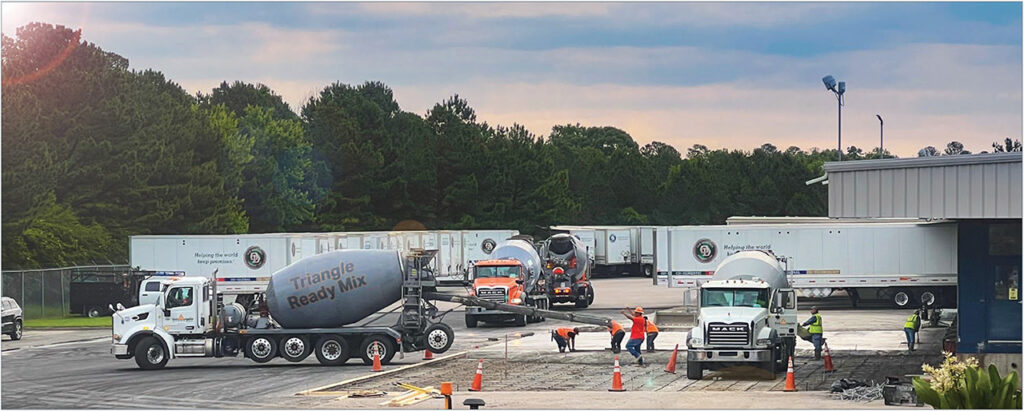
An Overview of Long-Life Concrete Pavement Construction
“Permanent Pavement” is more than a phrase — it’s a philosophy in modern concrete construction. It represents a design and construction approach focused on long-term durability, minimal maintenance, and structural resilience over decades of use.
While traditional asphalt or flexible pavement systems rely on periodic resurfacing and repair, permanent pavement concrete systems are engineered to last the life of the facility itself. These systems use high-strength, precisely batched concrete that can withstand heavy loads, environmental stress, and constant use — making them ideal for commercial and industrial applications where reliability and performance are critical.
The Difference: How Permanent Pavement Stands Apart
Permanent pavement construction differs from typical commercial concrete work in both purpose and performance. While many commercial concrete applications — like sidewalks, curbs, and building slabs — are designed for moderate use, permanent pavement is designed for endurance under high stress. Key distinctions include:
- Thickness and Reinforcement: Permanent pavement is typically thicker, often reinforced with steel mesh or dowel bars to control load transfer and prevent cracking.
- Mix Design: It uses a higher-strength concrete mix with optimized aggregate grading, lower water-cement ratios, and precise admixture control for long-term performance.
- Load Capacity: Engineered to support heavy industrial traffic, equipment, and vehicles, from loaded semis to forklifts & cranes.

- Longevity and Maintenance: Designed for 40–50 years of service with minimal repairs, as opposed to resurfacing every 10–15 years typical of asphalt systems.
- Construction Standards: Permanent pavement often follows stricter flatness, jointing, and curing specifications to ensure long-
term integrity.
In essence, permanent pavement bridges the gap between everyday concrete slabs and heavy-duty infrastructure — offering the strength of an airfield runway in the footprint of a factory floor.
Where Permanent Pavement Matters Most
Permanent pavement is the backbone of environments where the surface takes a beating day after day. Its strength and reliability make it essential in settings such as:
Intermodal Facilities
Intermodal facilities are large transportation hubs where freight is transferred between different modes of transport — for example, from trains to trucks, or from ships to rail. These facilities are vital links in the global supply chain, handling enormous volumes of cargo under tight schedules.
Because these areas experience constant, heavy traffic from tractor-trailers, cranes, shipping containers, and specialized yard equipment, the pavement must endure extreme weight, turning forces, and continuous use. Permanent pavement concrete provides a rigid, long-lasting surface that resists rutting, shifting, and cracking — ensuring smooth, uninterrupted operations and reducing costly downtime for maintenance.
Factory and Warehouse Floors
Inside manufacturing plants, distribution centers, and warehouses, the floor isn’t just a surface — it’s part of the production system. Permanent pavement supports heavy racking, forklifts, and machinery without deformation. It stays level, flat, and strong — ensuring efficiency and safety throughout decades of industrial use.
Parking and Storage Areas
For commercial vehicle parking lots, storage yards, and loading areas, permanent pavement eliminates the need for frequent resurfacing. Its strength resists oil degradation, surface deformation, and cracking — ideal for facilities that handle heavy fleets or outdoor storage of materials and equipment.
Transportation and Logistics Hubs
Airports, freight terminals, and ports demand surfaces that handle high wheel loads and constant movement. Permanent pavement’s rigidity, smoothness, and durability make it the preferred choice where failure isn’t an option.
Engineering for the Long Term
Permanent pavement design integrates a few critical engineering principles that set it apart:
- Subgrade and Base Optimization: Proper grading and base compaction ensure uniform load distribution and prevent differential settlement.
- Joint Design: Thoughtful joint spacing and load transfer mechanisms reduce cracking and joint faulting over time.
- Curing and Finishing: Controlled curing preserves moisture for complete hydration & long-term strength and surface hardness.
- Precision Batching and Mixing: Advanced technologies, such as inline aggregate blending and automated batching systems, guarantee consistent quality from the first truck to the last.
These combined factors create a pavement system that doesn’t just perform well today — it performs well for decades.
The Economic and Environmental Advantage
Though the initial installation cost of permanent pavement can be higher than asphalt, the lifecycle cost is significantly lower. Fewer repairs, less downtime, and longer service life reduce both operational disruption and total expense over time.
Environmentally, permanent pavement also contributes to sustainability by reducing material consumption, waste generation, and the carbon footprint associated with frequent resurfacing. With proper mix design and recycling of returned concrete, permanent pavement aligns well with modern sustainability goals in construction and infrastructure development.
Conclusion: The Foundation for the Future
In every way that matters — structural integrity, performance, and longevity — permanent pavement represents the future of heavy-use concrete construction. From intermodal terminals and factory floors to parking facilities and logistics hubs, it stands as proof that building once, and building well, is the most sustainable choice of all.